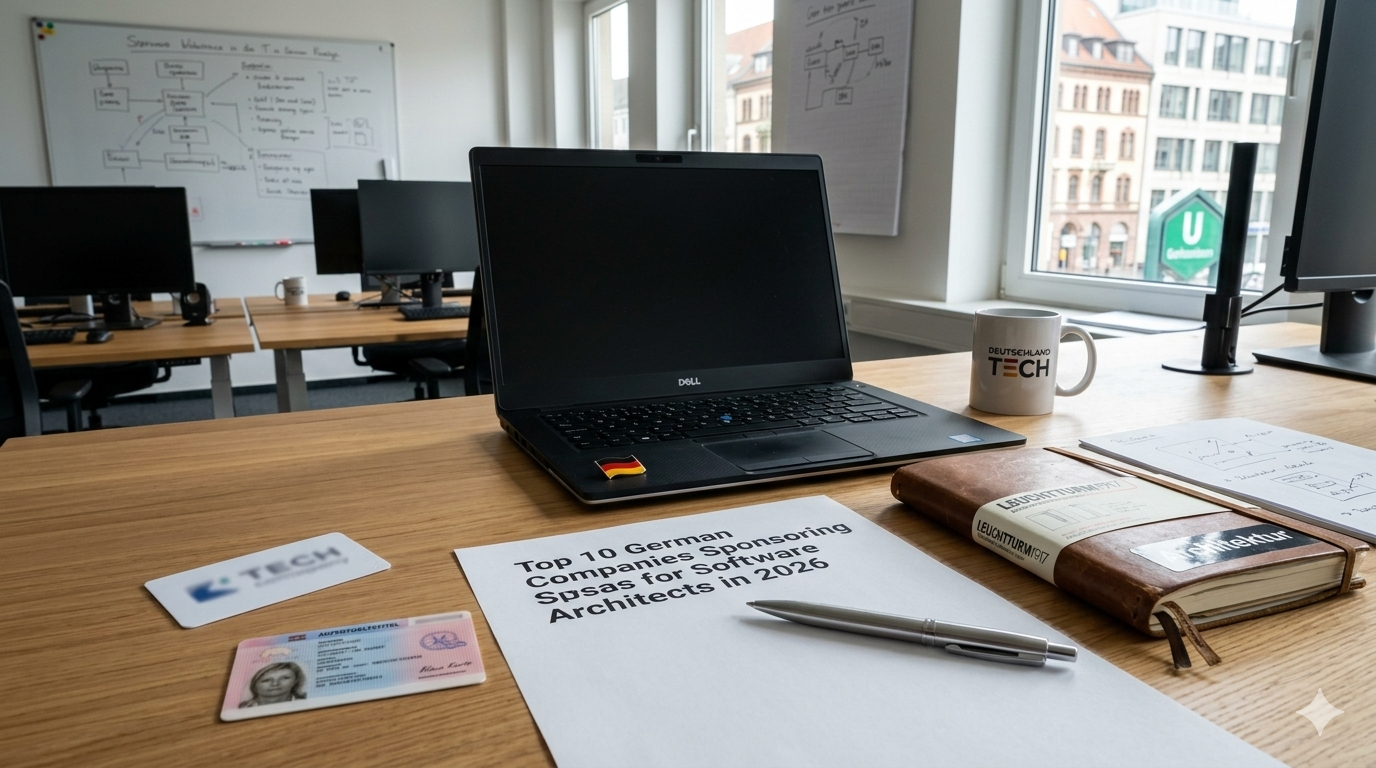
Germany is no longer just the land of cars and high-quality manufacturing; in 2026, it has solidified its position as Europe’s premier destination for high-level software engineering and system architecture. As the “engine room” of the European Union, Germany is undergoing a massive digital transformation, moving away from legacy monolithic systems toward distributed, cloud-native, and high-concurrency architectures.
The most critical bottleneck in this transformation is not a lack of junior developers, but a desperate shortage of Software Architects. These are the “master builders” who can design scalable systems, implement Clean Architecture, and lead complex migrations. To address this, German tech giants and high-growth unicorns have removed traditional barriers, offering massive relocation packages, fully English-speaking environments, and “express” visa sponsorship for qualified architects.
If you are a Senior Developer or Architect looking for a life-changing career move, this guide is your 2026 blueprint. We have identified the top 10 companies currently sponsoring visas, the architectural patterns they value most, and the exact step-by-step process to secure your €130,000 contract and move to Germany this year.
Why Software Architects are “Recession-Proof” in Germany
While the global tech market has seen fluctuations, the demand for Architects in Germany has remained remarkably stable. This is because German industry—from banking in Frankfurt to automotive in Stuttgart—is built on long-term infrastructure.
In 2026, German companies are focusing on three main architectural pillars:
- Sovereign Cloud & Security: Moving away from US-based dependencies toward localised, secure cloud solutions.
- Industry 4.0 / IoT: Connecting physical manufacturing with digital twin technology.
- Modernising Legacy Finance: Transitioning the world’s most stable financial institutions from COBOL to Microservices.
Because these projects are multi-year and mission-critical, companies are willing to pay a premium. A Software Architect in Berlin or Munich can now command a base salary between €110,000 and €140,000, often with stock options and performance bonuses that push the total compensation even higher.
Top 10 German Companies Sponsoring Visas in 2026
These companies have dedicated “Expat Onboarding” teams that handle your visa application, find you temporary housing, and even help you register your family in the local German system.
1. SAP (Walldorf/Berlin)
As the world leader in enterprise software, SAP is the largest sponsor of tech visas in Germany. They are currently hiring architects to lead the transition of their ERP systems to the cloud. They are looking for experts in Java, Cloud-Native architecture, and Microservices.
- Architectural Focus: High-availability enterprise systems.
- Visa Speed: High (Recognised Sponsor).
2. Siemens (Munich/Berlin)
Siemens is at the forefront of the “Industrial Metaverse.” They need architects who can design systems for smart cities, renewable energy grids, and automated factories.
- Architectural Focus: IoT, Digital Twins, and Embedded Systems.
- Visa Speed: Very Fast (Tier 1 Global Sponsor).
3. Zalando (Berlin)
Europe’s leading fashion platform is a haven for architects who love high-concurrency systems. Zalando’s tech stack is modern, and they are famous for their “Radical Agility” approach to architecture.
- Architectural Focus: Event-driven architecture, Scala, and AWS.
- Visa Speed: High (Fully English-speaking tech hub).
4. Delivery Hero (Berlin)
Operating in over 70 countries, Delivery Hero needs architects to manage massive multi-tenant SaaS platforms that handle millions of transactions per second. They are aggressive recruiters from the global south (Africa, Asia, and South America).
- Architectural Focus: Multi-tenancy, Real-time systems, and WebSockets.
- Visa Speed: Excellent (Specialised relocation department).
5. HelloFresh (Berlin)
As a global leader in meal kits, HelloFresh focuses heavily on logistics and supply chain architecture. They value architects who can implement Domain-Driven Design (DDD) and manage complex data pipelines.
- Architectural Focus: DDD, Logistics optimisation, and Python/Go.
- Visa Speed: High.
6. Bosch (Stuttgart/Dresden)
If you are interested in the intersection of hardware and software, Bosch is the premier choice. They are hiring architects for autonomous driving projects and smart home ecosystems.
- Architectural Focus: AI-driven systems and Automotive Software Architecture (AUTOSAR).
- Visa Speed: Reliable (Strong corporate support).
7. Mercedes-Benz Tech Innovation (Stuttgart/Berlin)
The digital arm of Mercedes-Benz is building the “Operating System” for the cars of the future. They prioritise architects with a strong background in Clean Architecture and Cloud-to-Vehicle communication.
- Architectural Focus: Cloud Infrastructure and Real-time data processing.
- Visa Speed: Fast (Premium relocation support).
8. Deutsche Bank (Frankfurt/Berlin)
The banking giant is in the middle of a massive tech overhaul. They are looking for architects who can design secure, compliant financial systems using modern tech stacks.
- Architectural Focus: Fintech, Blockchain, and Secure Microservices.
- Visa Speed: Consistent (Global hiring presence).
9. BioNTech (Mainz/Berlin)
The company that revolutionised vaccines is now a major tech player. They need software architects to build the digital platforms for personalised cancer treatments.
- Architectural Focus: Big Data, Bioinformatics systems, and Healthcare security.
- Visa Speed: High Priority.
10. Allianz (Munich/Stuttgart)
The global insurance leader needs architects to manage massive legacy migrations and build the next generation of mobile-first insurance products.
- Architectural Focus: Legacy-to-Cloud migration and Mobile System Architecture.
- Visa Speed: Steady.
Architectural Patterns German Companies Value in 2026
To land an interview with these giants, you must prove you are not just a “coder,” but a “designer.” German technical interviews are rigorous and focus heavily on First Principles.
- Clean Architecture: German firms love the separation of concerns. If you can explain how you implement Clean Architecture to keep the business logic independent of frameworks and UI, you will stand out.
- MVVM & Modularisation: For mobile and frontend-heavy roles, being able to architect modular systems that allow multiple teams to work on the same codebase without conflict is a highly prized skill.
- Microservices vs. Modular Monolith: You should be able to argue the pros and cons of both. In 2026, many German firms are moving toward “Modular Monoliths” to reduce DevOps complexity—being able to discuss this trend shows high-level architectural maturity.
- SaaS Multi-tenancy: As German “Mittelstand” companies build their own SaaS products, understanding database sharding, tenant isolation, and shared infrastructure is a massive plus.
Understanding the 2026 EU Blue Card for Architects
The German government significantly lowered the requirements for the EU Blue Card in 2026, making it the most efficient way to relocate.
The Benefits of the Blue Card for Architects:
- Lower Salary Threshold: For “bottleneck” professions like Software Architecture, the required salary is significantly lower than the national average (though as an Architect, you will naturally earn well above this).
- Fast Permanent Residency: If you speak basic German (B1 level), you can apply for permanent residency in as little as 21 months.
- Family Rights: Your spouse can move with you and is granted an immediate, unrestricted work permit. They do not need to speak German to qualify.
- Mobility within the EU: After 12 months, you can move to another EU country for work with a simplified process.
The Financial Breakdown: Is €130,000 Enough?
In Germany, your “Gross” (Brutto) salary and “Net” (Netto) salary can look very different due to the strong social safety net.
- Tax Class 1 (Single): On €130,000, your take-home pay is approximately €6,500 per month.
- Tax Class 3 (Married, one income): Your take-home pay jumps to approximately €7,400 per month.
Monthly Expenses in a Major City (Berlin/Munich):
- Rent (Modern 2-bed): €1,800 – €2,500
- Groceries/Dining: €800
- Utilities/Internet: €300
- Public Transport: €49 (The Deutschland-Ticket)
- Monthly Savings Potential: €3,000 – €4,500.
While the taxes are high, you must remember that this covers your healthcare, your pension, and your children’s education (from kindergarten to PhD).
The Step-by-Step Blueprint to Your German Job Offer
Success in the German market requires a “precision-first” approach. Follow these steps to maximise your conversion rate.
- Step 1: The “Germanized” Resume. Your CV must be technical and factual. Avoid “fluff” and buzzwords. Focus on specific architectural decisions you made, the scale of the users you handled, and the technical debt you resolved. Use a clean, professional photo—it is still standard practice in Germany.
- Step 2: Optimise for Niche Job Boards. While LinkedIn is great, German recruiters spend more time on Xing and specialised platforms like HoneyPot.io or Ottie.com, which are designed specifically for visa-sponsored tech roles.
- Step 3: The Technical Assessment. Be prepared for “System Design” interviews. You will likely be asked to draw a high-level architecture on a whiteboard (or digital equivalent) and defend your choice of database, caching strategy, and communication protocols.
- Step 4: The Cultural Interview. German companies value “Reliability” and “Directness.” Be honest about what you don’t know, and show a commitment to long-term architectural stability over “quick fixes.”
- Step 5: The Visa Process. Once you have the signed contract, the company’s HR will typically initiate the “Fast-Track Procedure for Skilled Workers.” You will book an appointment at the German Embassy, and your visa is usually issued within 2 to 4 weeks.
Final Tips for the Relocating Architect
Relocating to Germany is a long-term investment. To ensure a smooth transition, start learning basic German today. While your work environment will be 100% English, being able to handle a rental contract or a doctor’s visit in German will significantly reduce your stress.
Furthermore, focus on building a presence on GitHub or a technical blog. German architects are expected to be “thought leaders” within their teams. Showing that you contribute to open source or write about MVVM patterns and Clean Architecture will prove you have the seniority they are paying for.
Germany in 2026 is the land of opportunity for the skilled Software Architect. The companies are hiring, the visas are ready, and the salaries have never been higher. Start your application process today and secure your future in the heart of Europe.
I love this , please I need you to enlighten me more